
As Mount Pleasant Group marks 200 years in 2026, we’re sharing stories that reflect the families, lives and histories connected to our cemeteries through our 200 Stories Project. As part of this initiative, we welcome people sharing their family connections to our history. Recently, we heard from local Toronto resident Mary Gordon, who shared her family’s story with us.
Mary has been researching family history for more than three decades. Long before online databases and searchable records, she spent hours scrolling through microfilm, piecing together names, dates and relationships. What began as a hobby slowly grew into something much larger: a living record of thousands of people connected by blood, marriage and migration.
“Like most people, what really fascinates me is how people got where they ended up in the context of their lives,” said Mary.
That curiosity eventually led her to an unexpected place in Toronto’s past: Potter’s Field, the city’s first non-denominational burial ground and the first cemetery operated by the entity known today as Mount Pleasant Group, and then located at the intersection we know today as Yonge and Bloor. Public pressure on government from the residents of Yorkville led to the closure of Potter’s Field in 1875. All the remains buried there were relocated to either the Toronto Necropolis in Riverdale or to the Mount Pleasant Cemetery.
Mary traced her husband John Bertram’s family roots back to Toronto (then called the town of York) in the early 1830s. As cemetery records became available online, Mary began searching for familiar surnames and soon discovered that four members of John’s family, the Robinsons, were buried in Potter’s Field.
One was John’s great-great-great-grandfather, John Robinson, who died on August 15, 1834. Just days earlier, the family had also lost Mary Ann Robinson, the infant first child of John Robinson’s son Isaac and Isaac’s wife Ruth. Both deaths were caused by cholera.
Two decades later, tragedy struck the family again. In July 1854, Isaac and Ruth Robinson lost their two youngest daughters, Hannah Louise and Ellen Amelia, within a single week. Ellen died of scarlet fever. While the cause of Hannah’s death is unrecorded, it is likely she succumbed to the same illness, which was widespread and often fatal in the mid-19th century.
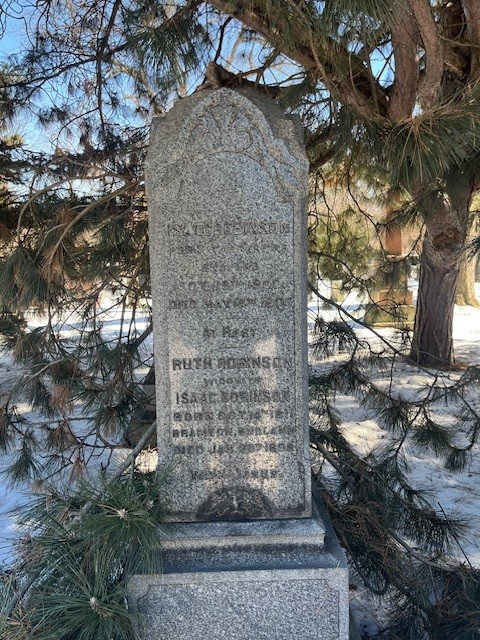
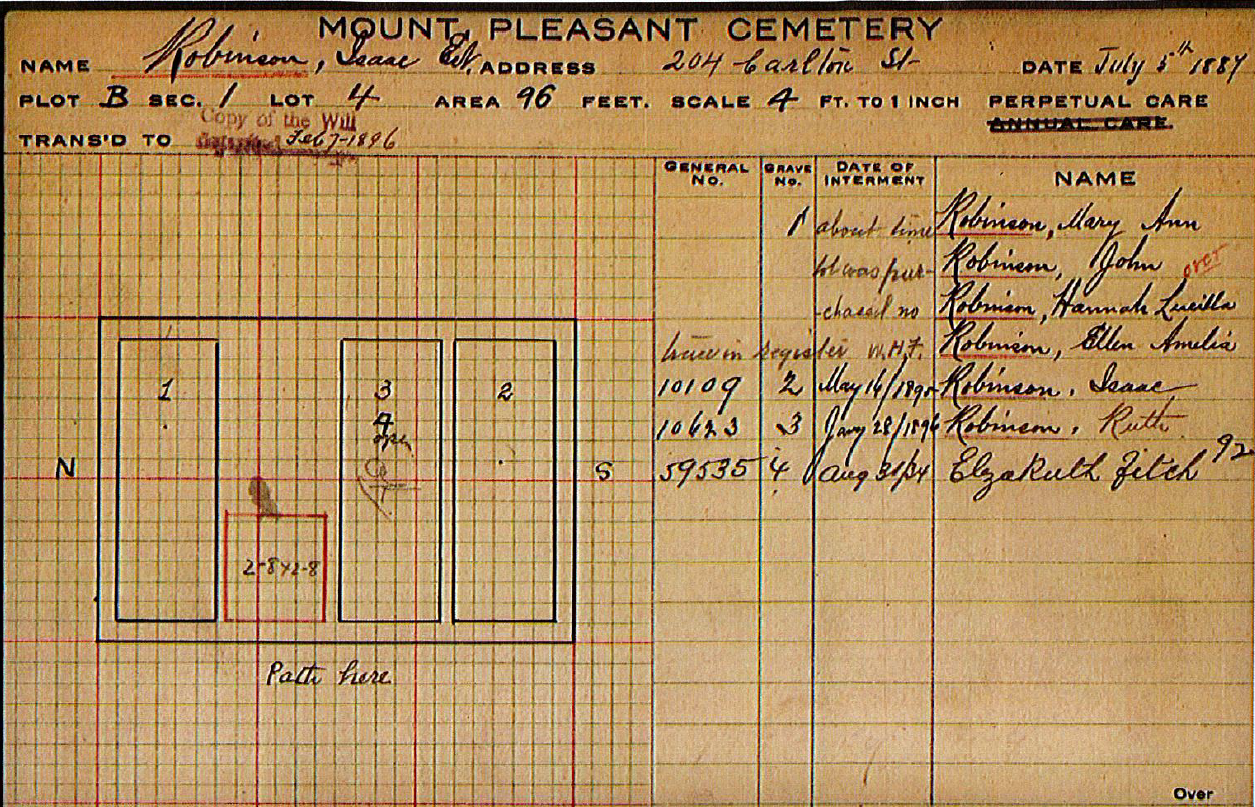
Today, members of the Robinson family – John, Mary Ann, Hannah and Ellen – rest together at Mount Pleasant Cemetery in Plot B, Section 01, Lot 4, their names carved into a single headstone. They are joined by Isaac and Ruth Robinson, and their daughter Elizabeth Fitch, who were originally buried at Mount Pleasant. Mary knows the spot well.
“I go visit all the time, it’s right inside the gates,” she said. “You can see it. It’s right there.”
Mary makes sure their stories are easier for others to find, documenting the family on Find a Grave and adding as much historical context as possible. Potter’s Field offers little to work with now, having long since vanished beneath the city, but Mount Pleasant Cemetery gives the family a place to return to and a place to remember their ancestors.
The Robinsons were part of Toronto’s earliest chapters. Isaac Robinson, John’s great-great-grandfather, arrived from Yorkshire, England in 1831. He was a tailor by trade and deeply involved in Primitive Methodism, a religious movement that took root in York during the 1830s. Through marriage, the family was connected to Robert Walker, who went on to operate the Golden Lion, one of Toronto’s most prominent 19th-century department stores, on King Street. Over Isaac’s lifetime, he would have witnessed Toronto transform from a small colonial town into a rapidly expanding city. He died in 1895.
What strikes John most about this discovery is how much easier it is to be alive in the 21st century.
“They got married, they had a child who died, then another who lived only two months and died,” said John. “Life was just so much harder back then. It makes you appreciate how different things are now.”
The discoveries haven’t ended. As Mary continues her research, new connections emerge – some close to home, others stretching across continents and centuries.
“Every discovery leads to more questions and more appreciation,” John said. “We are here because they were here.”
Uncovering the Robinsons’ story feels less like digging up the past and more like restoring it. Their names are no longer lost to a vanished burial ground. They are spoken, recorded, visited and remembered.
“It’s not just about DNA,” said John. “It’s about lives, stories and understanding how we came to be.”
And now, just inside the gates at Mount Pleasant Cemetery, the Robinson family rests where their story can finally be seen, rooted once more in the city they helped shape.
MPG presents our 200 Stories Project to commemorate our 200th anniversary in 2026 and invites the public to journey through 200 stories at mpg200.ca.


